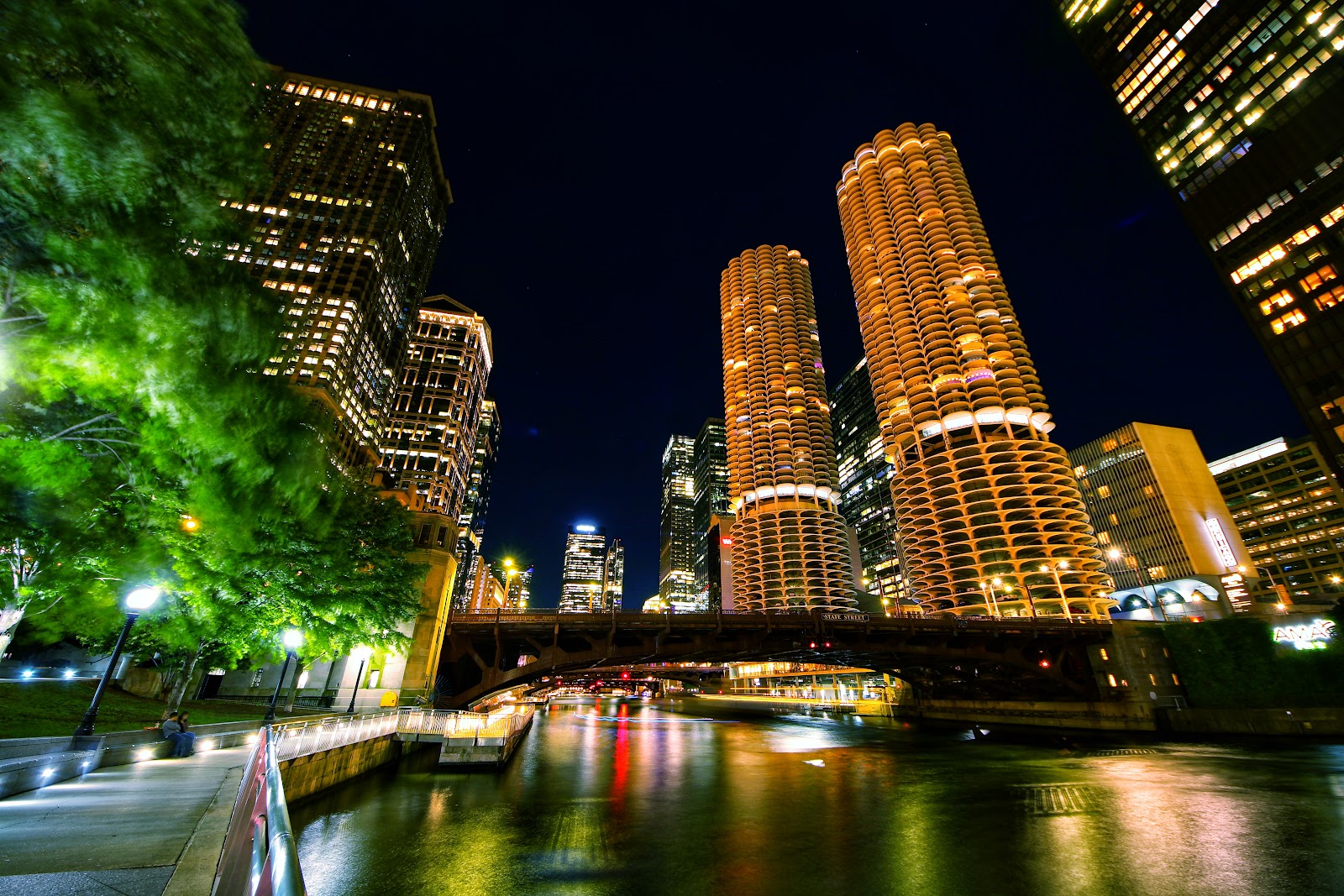
Two round concrete towers with scalloped edges, sixty-five stories each, sitting right on the water. Everyone calls them the corn cobs. Their real name is Marina City, and they were designed by a Chicago architect named Bertrand Goldberg who thought the rectangle was a failure of imagination.
When they went up in the early sixties, they were the tallest apartment buildings in the world and the tallest concrete structures of any kind. His argument was that a circle uses less material to enclose more space, and that people don't actually live in corners. So the towers went up core first — a hollow concrete shaft climbing ahead of everything like a chimney — with the floors poured around it as the crews rose. Sixteen apartments per floor, every one a wedge, every one ending in a curved balcony. That's the corn cob. It's nine hundred balconies.
The money is the part I didn't expect. Marina City was financed by a union — the Building Service Employees: janitors, elevator operators, window
washers. Downtown Chicago in the fifties was emptying out to the suburbs after five o'clock, and the union did the math on that. No residents means no offices, no offices means no buildings, and no buildings means nobody needs a janitor. So they put thirty-six million dollars into an experiment to make people live downtown again.
It was sold as a city within a city, almost literally. Apartments,