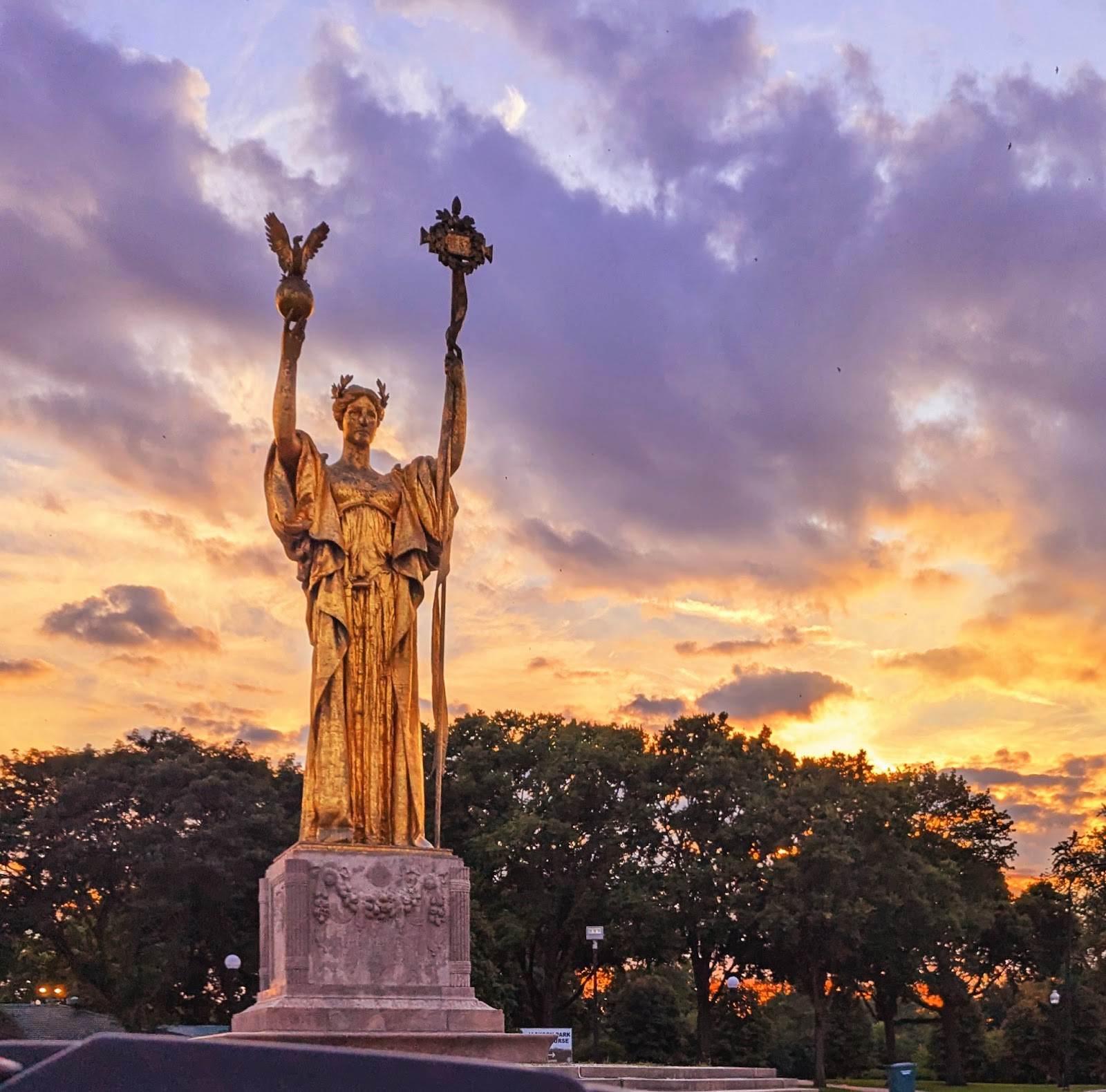
The gold woman. Twenty-four feet of gilded bronze standing at a road junction in the middle of a park, arms up, holding a globe and a staff, looking north. Locals call her the Golden Lady.
She's a copy. And she's a copy of something that isn't here anymore.
In eighteen ninety-three this park held the World's Columbian Exposition, and at the center of its main basin stood a version of this same figure that was sixty-five feet tall. Same sculptor, a man named Daniel Chester French. Twenty-five years later, Chicago wanted a permanent marker of the fair, so they went back to French and had him make this one at roughly a third of the size. The commission's instruction was that it stay under twenty-five feet — small enough that nobody could accuse the city of trying to rebuild the original.
French, incidentally, spent the years after this working on another commission you have definitely seen. He carved the seated Lincoln inside the Lincoln Memorial.
Now think about what stood where you'
re standing.
The fair was enormous — hundreds of buildings, a city of white palaces put up on filled marshland in about two years. And almost none of it was real. The buildings were wood frames sprayed with a plaster-and-fiber mix called staff, painted white, lit at night by an electrical system most visitors had never seen before. Twenty-seven million people came through. It reset how Americans