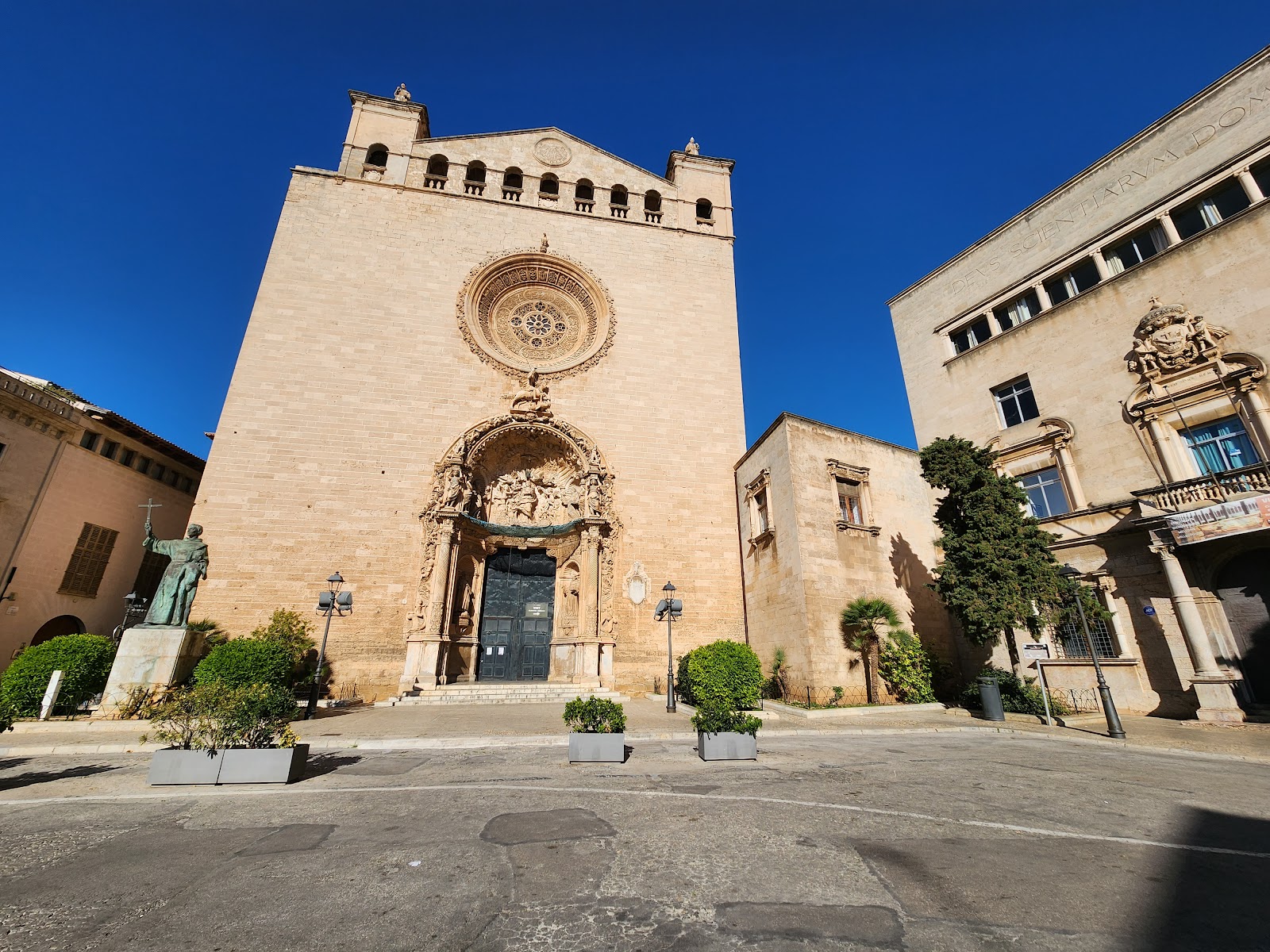
Basílica de Sant Francesc

Basílica de Sant Francesc

Mallorca, Spain

Big square, big Baroque front, one friar standing on a plinth out here in the middle.

Big square, big Baroque front, one friar standing on a plinth out here in the middle. The friar is Juníper Serra, who left this island and founded the missions that became San Diego and San Francisco — and California has been arguing furiously about his statues ever since.

But the man I want is inside, in a stone box in the first chapel on the left. His name was Ramon Llull, he was born a few streets from here in the thirteenth century, and he tried to build a machine that could prove God.

Not a metaphor. A device.

Llull started out as the least likely candidate imaginable. A rich merchant's son, a courtier, a writer of fairly sweaty love poetry. By his own later account, he once rode a horse into a church, because he was pursuing a woman who had gone in there to get away from him.

Then, in his early thirties, he had a series of visions. He gave away most of what he owned, made provision for his wife and children, and walked out of that life entirely.

And he came back with an idea

that nobody had had before.

Llull's idea was that arguing was inefficient. Two people of good faith disagree about the nature of God, they talk past each other for forty years, and nothing is resolved because human beings are bad at holding many ideas in their heads at once. So he built the thinking part outside the head. He made discs — circles of parchment, one inside another, each ring marked
Hear the full story

Hear this story with audio narration in the Bad Historian app.

Get the App

Quick Facts

  • Ramon Llull was born in Palma around twelve thirty-two to a merchant family and worked as a courtier and love poet before a series of visions changed his life.
  • Llull's Ars Magna used concentric lettered discs to generate combinations of concepts mechanically — an early attempt at automating reasoning.
  • Llull wrote in Catalan when scholarship was written in Latin, effectively founding Catalan as a literary language, and produced around two hundred and fifty works.
  • He learned Arabic in order to debate in his opponents' language, and travelled repeatedly to North Africa into his eighties, where he was imprisoned and expelled.
  • Llull's tomb in Sant Francesc has seven stone niches beneath it, intended to hold figures of the seven liberal arts, which were never carved.
  • Leibniz took Llull's combinatorial project seriously, and the line runs from it into formal logic.
  • The statue outside the basilica is Juníper Serra, the Mallorcan friar who founded the first missions in Alta California; his statues in California were toppled by protesters in twenty twenty.
Featured Tour

Everyone Wanted This Island

12 stops • 1h 15m

View Tour

Location

Mallorca, Spain
Open in Maps

More to explore in Mallorca