The address of this memorial is nineteen sixty-four Independence Avenue. They chose that number for the Civil Rights Act of nineteen sixty-four.
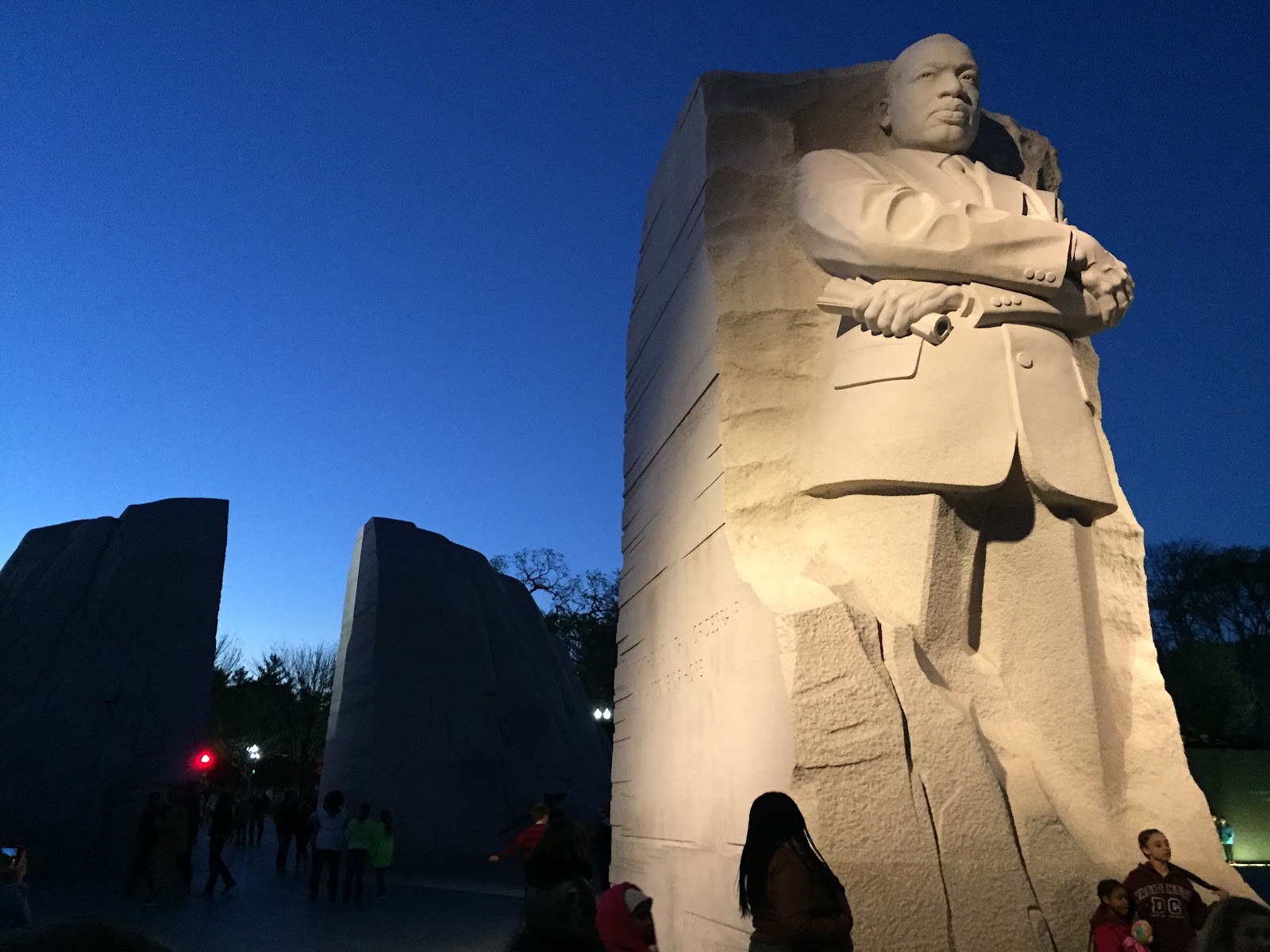
Look at the layout. Two massive boulders form the entrance — the Mountain of Despair. They were once a single stone, split apart. You walk through the gap between them — through the struggle — and on the other side stands the Stone of Hope. Thirty feet tall. Martin Luther King emerging from the rock, arms crossed, gazing out over the Tidal Basin.
The concept comes from a single line in the I Have a Dream speech. Out of the mountain of despair, a stone of hope.
Turn around and look at the sightlines. From where you're standing, you can see the Lincoln Memorial to the northwest — where King delivered that speech in nineteen sixty-three. And the Jefferson Memorial to the southeast — the man who wrote all men are created equal. This triangulation is deliberate. Three points on a map. The Declaration. The Gettysburg Address. I Have a Dream. A ge
ographic conversation about equality stretching two hundred years across the Tidal Basin.
The sculptor was Lei Yixin, a master carver from Changsha, China. He was found almost by accident. In two thousand six, Saint Paul, Minnesota hosted an international stone-carving competition. Because Saint Paul and Changsha are sister cities, Lei was invited. The memorial's architect, Ed Jackson Junior, hap