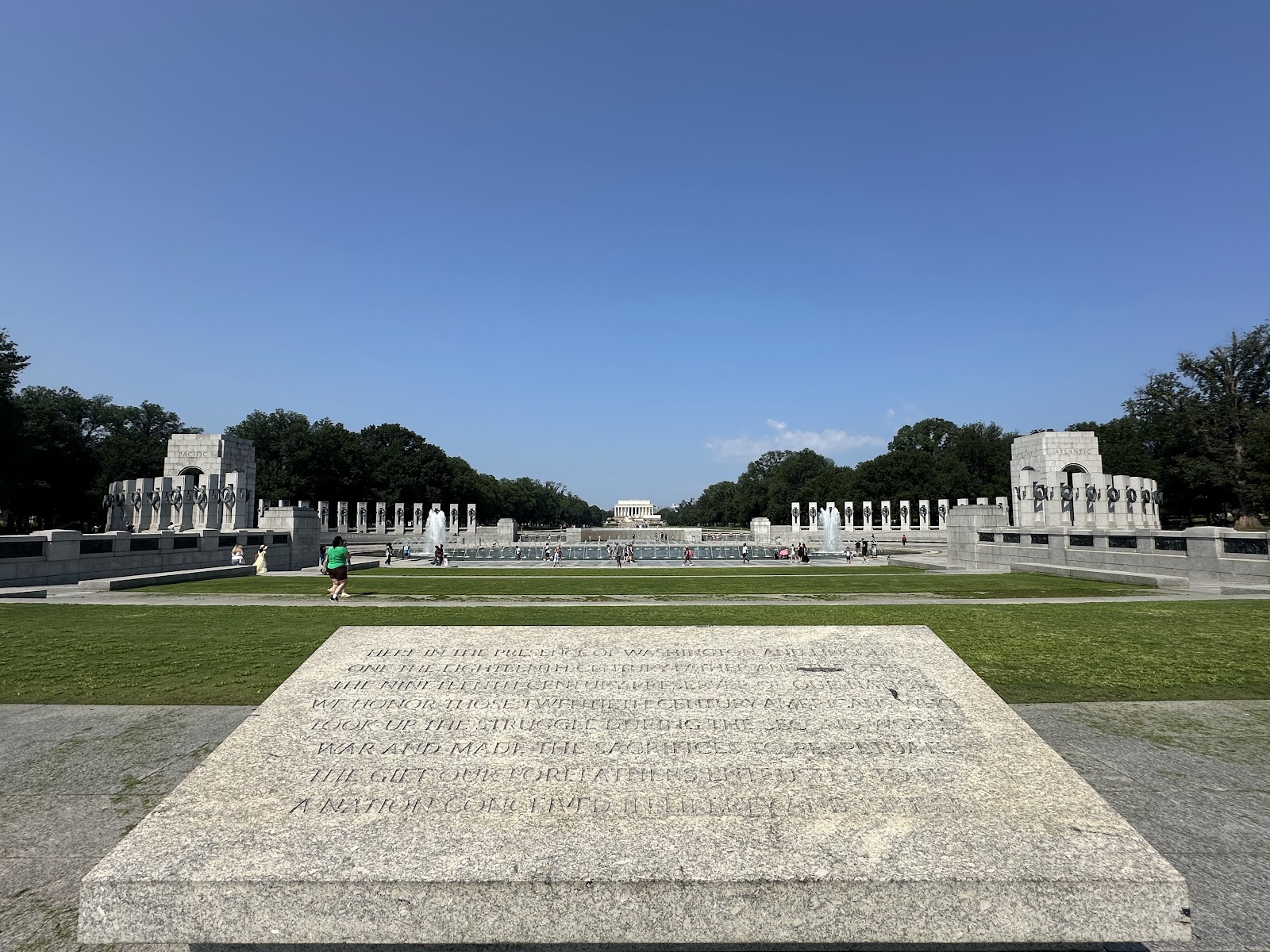
The World War Two Memorial. Fifty-six granite pillars. Two triumphal arches. A wall of gold stars. The whole thing cost a hundred and ninety-seven million dollars — almost all of it raised with private donations.
And it exists because of a fish fry.
In nineteen eighty-seven, a World War Two veteran named Roger Durbin walked up to his congresswoman at a fish fry in Curtice, Ohio — population two hundred and sixty-five — and asked a simple question. Why is there no memorial for World War Two veterans in Washington?
Marcy Kaptur introduced a bill. It failed. She introduced it again. Failed. A third time. Failed. On the fourth attempt, in nineteen ninety-three, it finally passed. Durbin had been asking for six years. He would wait seven more. He died in the year two thousand — four months before they broke ground. Thirteen years from one question at a cookout to a hole in the earth. And the man who started it never saw it.
The architect, Friedrich St. Florian, won a nationwide competit
ion against four hundred entries. He'd been born in Graz, Austria — a country swallowed by Nazi Germany when he was six. And critics called his design fascist. They compared it to the work of Albert Speer, Hitler's personal architect. An immigrant from a country the Nazis conquered designed America's memorial to beating the Nazis — and they called his work Nazi architecture. He called that stingin