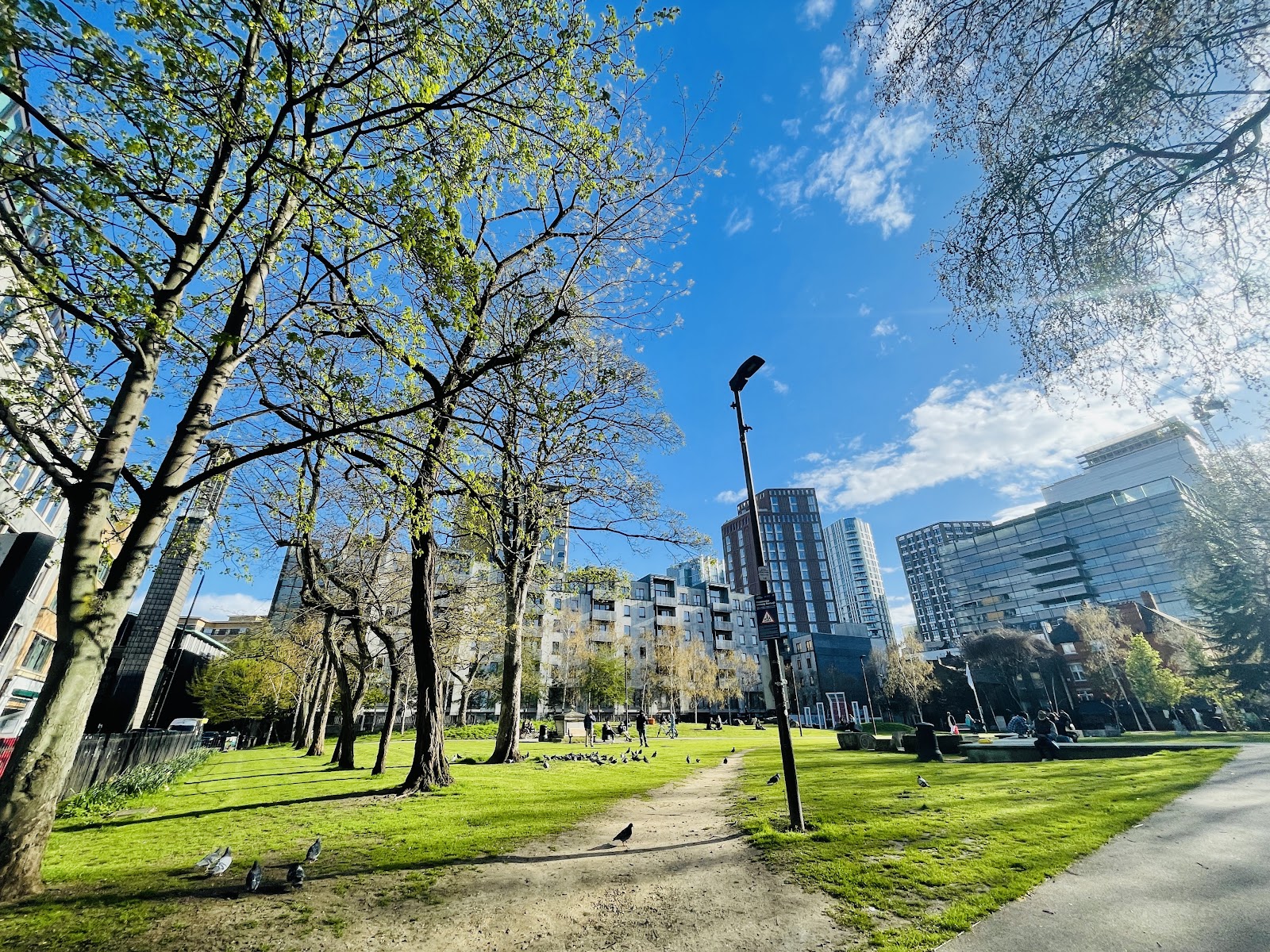
This small green park answers a question you might not have thought to ask: why is this area called Whitechapel? Because there was, literally, a white chapel. A medieval church stood right here, its walls whitewashed so brightly that people navigated by it and named the whole district after it. It was bombed in the Second World War and never rebuilt, and if you look at the ground, you can still trace its outline — the footprint of the church laid flat into the park, a seven-hundred-year-old building you walk through without walls.
But the park doesn't carry the church's name anymore. It's named after Altab Ali. And this is where the East End asks something of you.
Altab Ali was a young Bangladeshi clothing worker, twenty-four years old. In nineteen seventy-eight, walking home from work through these streets, he was murdered near this spot in a racist attack, for no reason on Earth except who he was. And the community did not let it be quietly forgotten. Ten days later, thousands of p
eople marched behind his coffin all the way to Downing Street, bringing the East End to a standstill. His death became a turning point — the moment the British Bengali community organized against the racist violence it was living with every day, and demanded to be treated as what it plainly was: part of this city, here to stay. In nineteen ninety-eight they renamed this park in his memory. And at