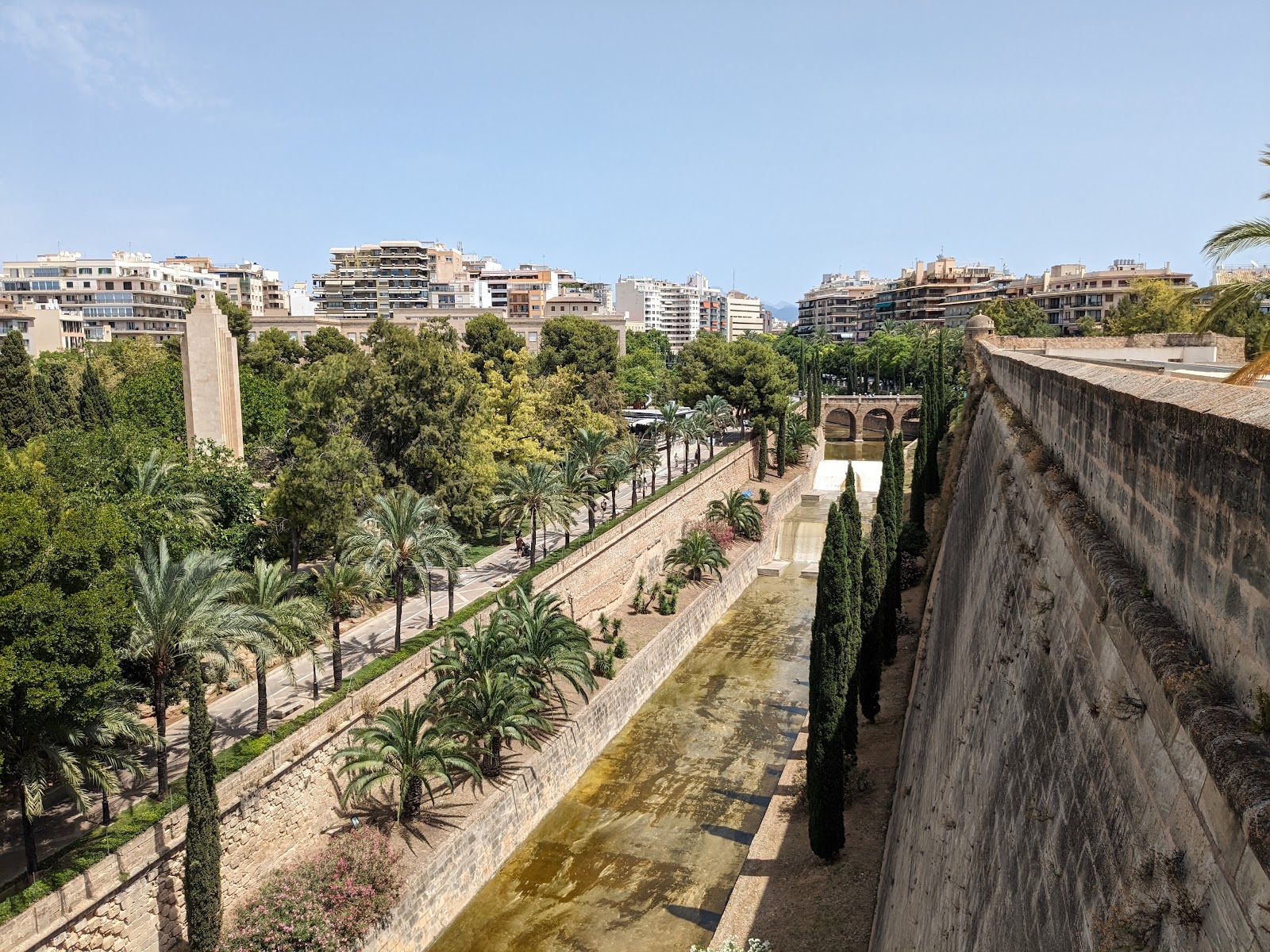
That enormous sloping stone flank, with the sea on the other side of it, is the Baluard de Sant Pere. Saint Peter's bastion. It's the corner of a wall that used to go all the way around this city, and putting your hand flat on it tells you most of what you need to know — it's warm, it's rough, and it's about as thick as a house is wide.
Palma was a walled city until the twentieth century. Not medieval walls by the end — these are Renaissance walls, angled and low and sloped, designed by an Italian military engineer to bounce cannonballs rather than stop them. Star-shaped, with bastions like this one at every point, so that every stretch of wall could be covered by fire from the next.
They were superb. They were also, by the eighteen hundreds, completely pointless. Artillery had moved on, and no fortress of this design was going to inconvenience anybody with a modern gun.
What the walls did do, very effectively, was strangle the city. Everyone inside was stuck inside: no room to buil
d, no room to widen a street, sanitation that does not bear thinking about, and a population that kept arriving anyway.
So in nineteen oh-two, Palma knocked its own walls down.
Think about that for a second, because in eight centuries of people turning up here to take this place, that was the first demolition the city chose. They took the walls apart themselves, on purpose, and built out into th