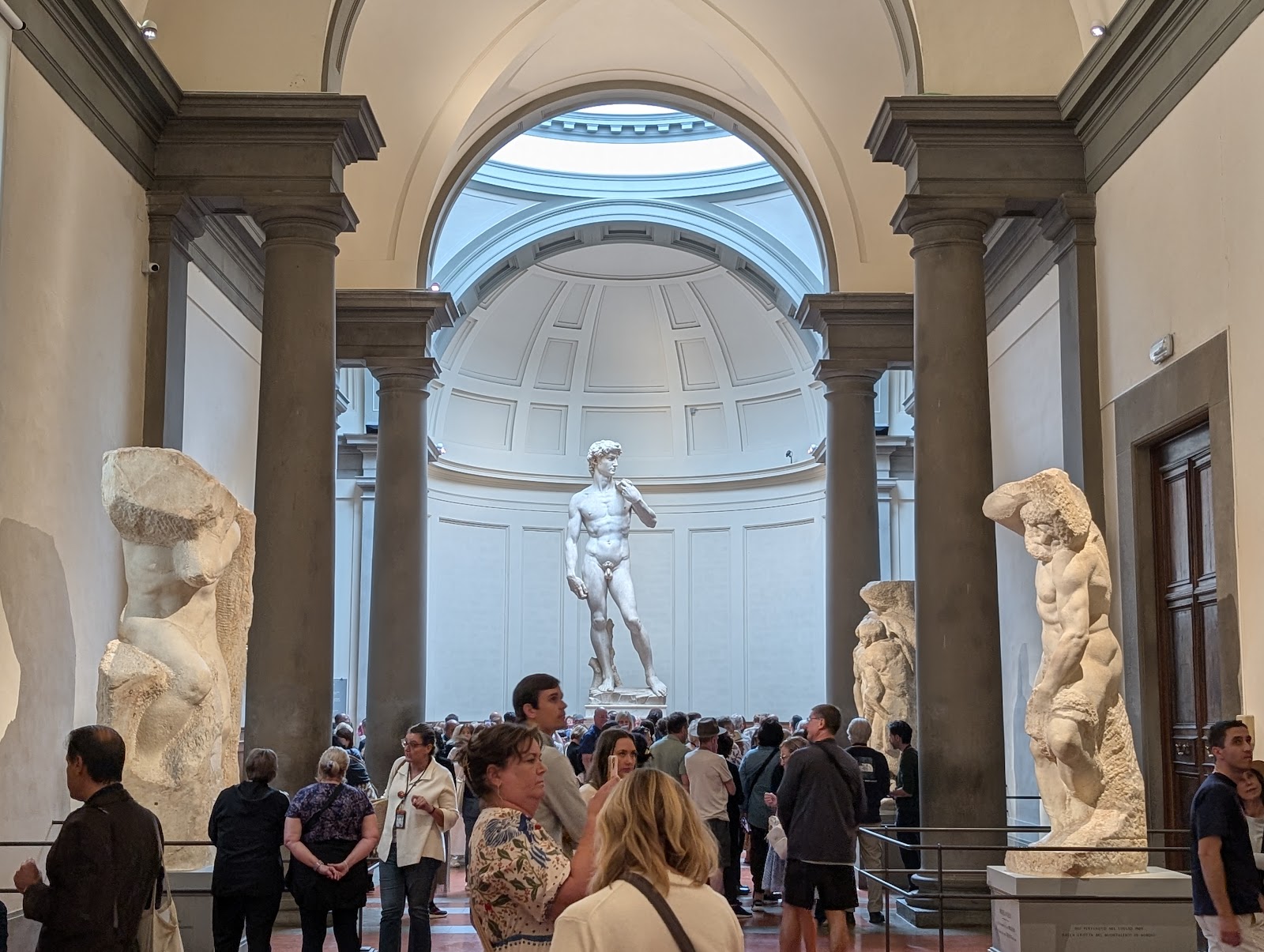
You've reached the Accademia. Before you get to the famous one at the far end of the hall, look at the figures lining the way to him — huge, half-finished bodies that seem to be fighting their way out of raw blocks of stone. Michelangelo's Prisoners. A shoulder surfacing here, a bent leg there, a torso straining to break loose, and the rest of each man still locked inside rough marble that was never cut away. He left them unfinished — and they may teach you more about how he actually worked than the perfect statue does.
Because sculpture, the way Michelangelo did it, is terrifying. A painter can paint over a mistake. A sculptor in marble can only take away. Every strike of the chisel is permanent — there is no gluing back a piece you've already removed. He believed the figure was somehow already inside the block, waiting, and his job was only to free it. So he'd sometimes start at the front and carve INWARD, as if the person were rising out of a bath, the highest points surfacing firs
t. Get one cut wrong and the whole figure is ruined, the stone is scrap, and months are gone. The Prisoners are that gamble, frozen mid-throw.
Now walk to the end, and there he is, under the skylight. The David. Seventeen feet of marble — and it was carved from a reject. The block was quarried decades earlier, and quarried badly: too tall, too narrow, too shallow from front to back. A sculptor to