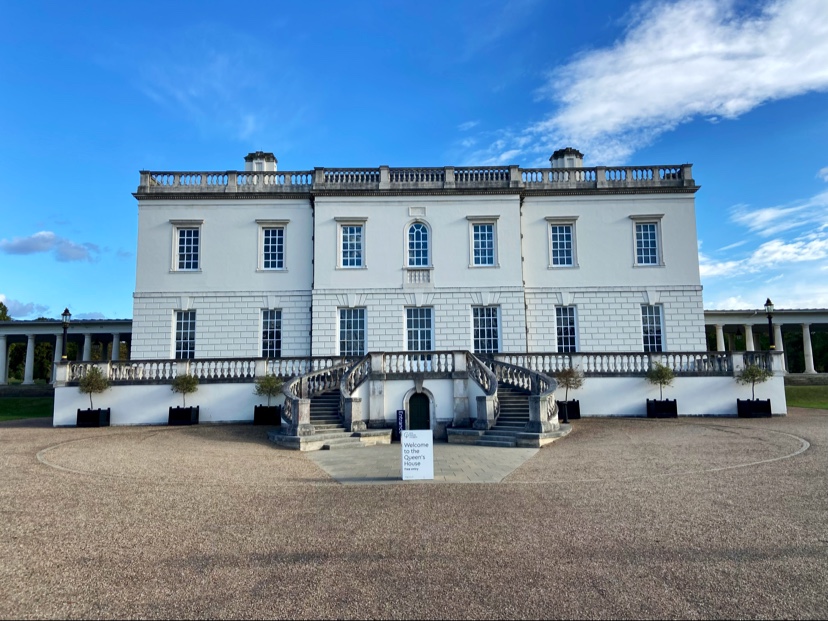
This is the Queen's House — the very view Wren had to split a palace in half to protect. It looks calm and plain, almost modern. And that plainness is exactly why it's one of the most important buildings in England. When it went up, starting in sixteen sixteen, it was a bombshell. Everything else in the country was Tudor — beams, gables, red brick, higgledy-piggledy. And the architect Inigo Jones dropped this cool, white, geometric, perfectly symmetrical Italian villa into the middle of it. It was the first proper classical building in Britain, and to people at the time it must have looked like a spaceship had landed in a field of thatched cottages. Every stately home you picture with white columns and clean symmetry — every one — traces back to this quiet little house being the first to try it.
There's a stranger detail in the original design, too: the house was deliberately built straddling the main public road, so the royal family could pass from one side to the other without ever
having to set foot on a road used by ordinary people. A house built as a bridge over the commoners.
It took two queens and a long gap to finish. Building started in sixteen sixteen for Anne of Denmark, the wife of James the First — but she died before it was done, work stopped, and the half-built shell sat abandoned for over a decade. It was finally completed for a different queen entirely: Henri