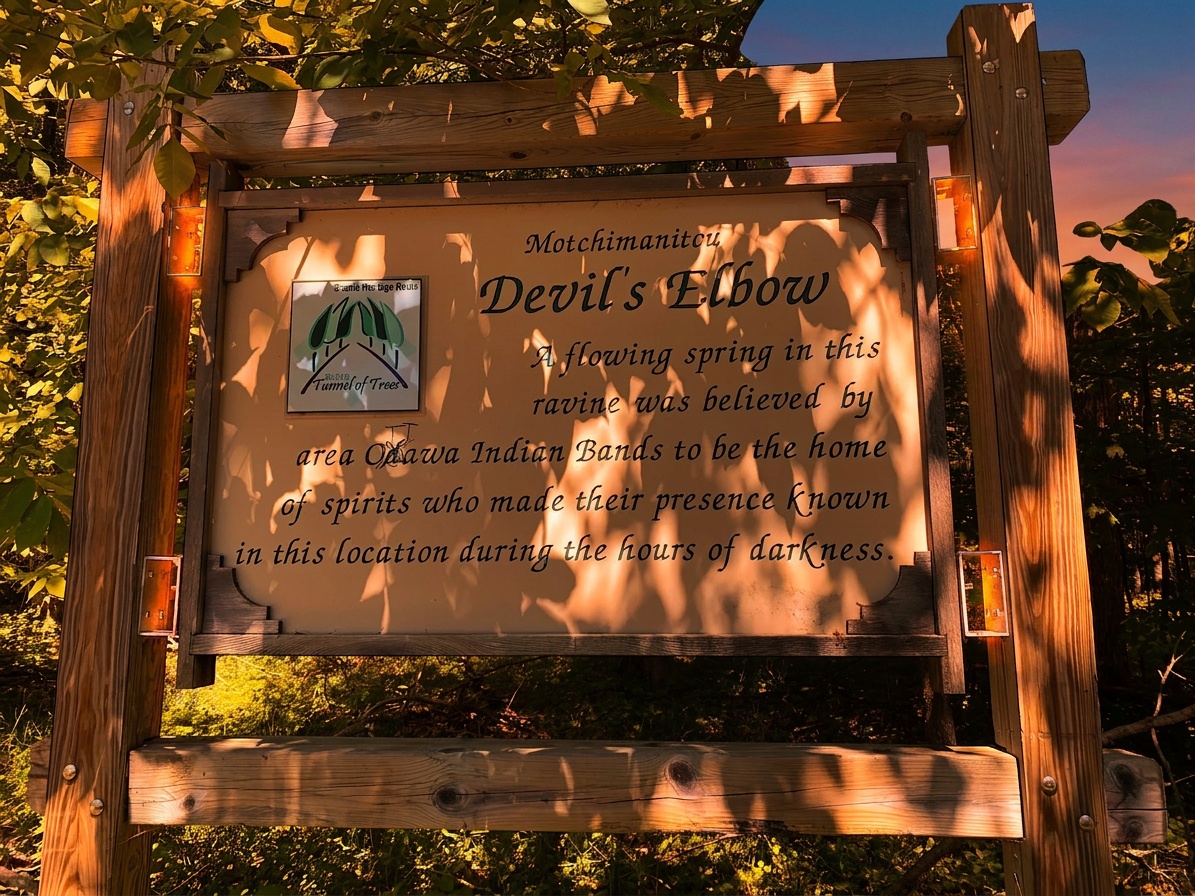
Slow down. The road is about to double back on itself in one of the sharpest curves on the whole route, a real white-knuckle hairpin, and there's a name for this spot that the highway crews and the locals have used for well over a century. Devil's Elbow. There's a marker near here. And there's a reason it's not called Pleasant Bend.
The oldest version of the story comes from Odawa oral tradition, and it centers on the ravine below the curve, where a cold spring runs. For a very long time, this hollow was understood to be a place where spirits made themselves known after dark — a place you passed through with respect, and preferably in daylight. Later tellings got more theatrical, the way these things do: that the devil himself scooped out the ravine, that people driving through after nightfall have heard voices with no source, distant drumming, seen lights flickering back in the trees where no lights should be.
Now, I want to be a responsible narrator here. I can't verify a single gh
ost. What I can tell you is that this exact curve has unsettled people, continuously, across cultures and centuries, which is itself a kind of fact. Something about the way the road folds back on itself, the way the cold air rises up out of that ravine even on a warm afternoon, the sudden deep shade — your body notices it before your brain does. You'll feel the temperature drop as you come through