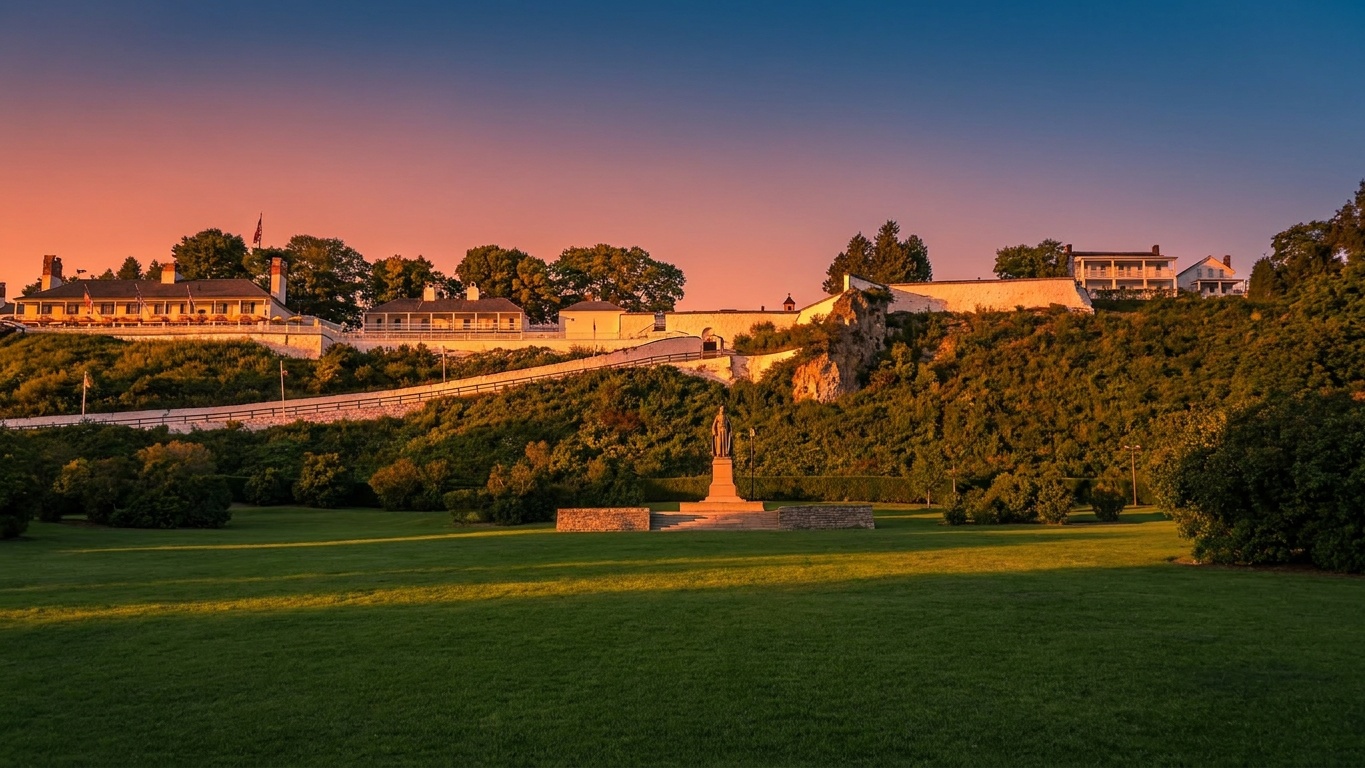
You climbed the hill, and it was worth it. You're at Fort Mackinac — long white limestone walls, black cannon pointing out over the harbor, the whole town and the blue straits laid out underneath you. It is a genuinely commanding position. Which makes it extra funny that the most important thing that ever happened here is that the fort surrendered without firing a shot, because the man in charge didn't know there was a war.
Here's the morning. It's July, eighteen twelve. The United States has just declared war on Britain — except news travels at the speed of a sailing ship out here, and nobody's told the American commander, a lieutenant named Porter Hanks, sitting up here with about sixty men. Meanwhile the British, who did get the news, moved fast. Overnight, a force of British regulars, a couple hundred fur-trade voyageurs, and around four hundred Native allies landed on the far side of the island, quietly, in the dark. They dragged a cannon up to the high ground behind the fort — g
round that looks straight down into it. And when the sun came up, Lieutenant Hanks walked outside to discover that his commanding, unassailable fort was, in fact, being commanded by somebody else's artillery, from above.
Hanks genuinely could not believe it. The story goes that before he'd surrender, he sent a man out under a white flag to ask the British to confirm that there was actually a war