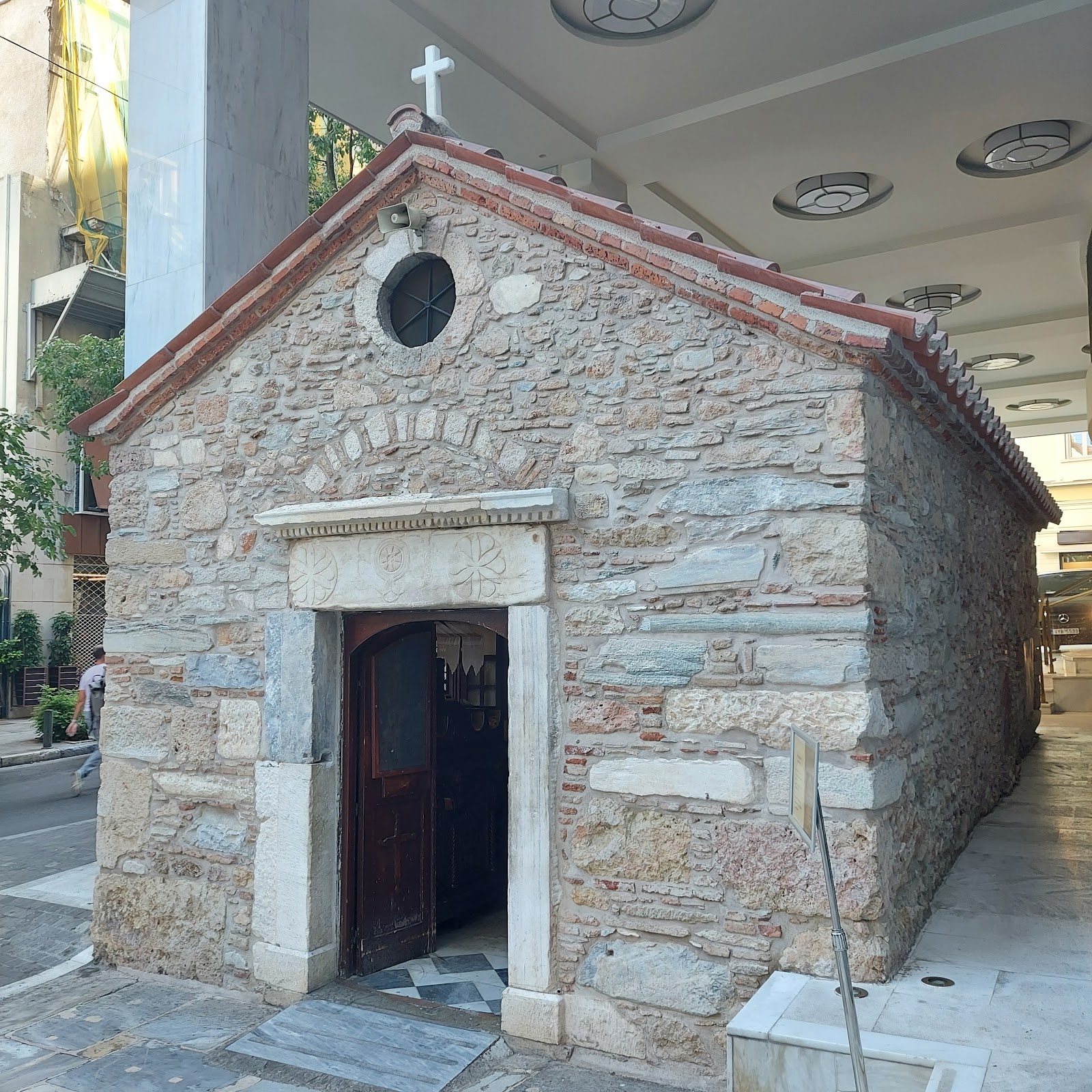
This is the church of Agia Dynami, and the reason people walk past it is that there's a hotel standing on top of it. Find the two square concrete pillars on either side of the little domed chapel. The whole building above is resting on those. The church sits underneath in the gap, like something somebody left in a doorway and then built around.
It's sixteenth century, about the size of a large living room, and still a working church. Services, candles, a priest, the lot — with nine storeys of hotel parked over the roof.
The chapel's own foundation is sitting on the city wall the Athenians threw up in a panic after the Persian wars. They rebuilt those defences so fast that they used gravestones and broken statues as bricks. So the chapel is standing on somebody else's salvage job, two thousand years older than itself.
It belonged to a monastery up on Mount Penteli — the mountain that supplied the marble for the Parthenon. This was their outpost in town, the place where the monks stay
ed when they came down to do business.
What went up above it, in the middle of the twentieth century, was the Ministry of Education and Religious Affairs. That is the department that decides which old buildings in Greece are worth keeping. It put its headquarters on top of one, and had to stand the whole building on legs to do it. Nobody was making that joke on purpose. Those pillars are there be