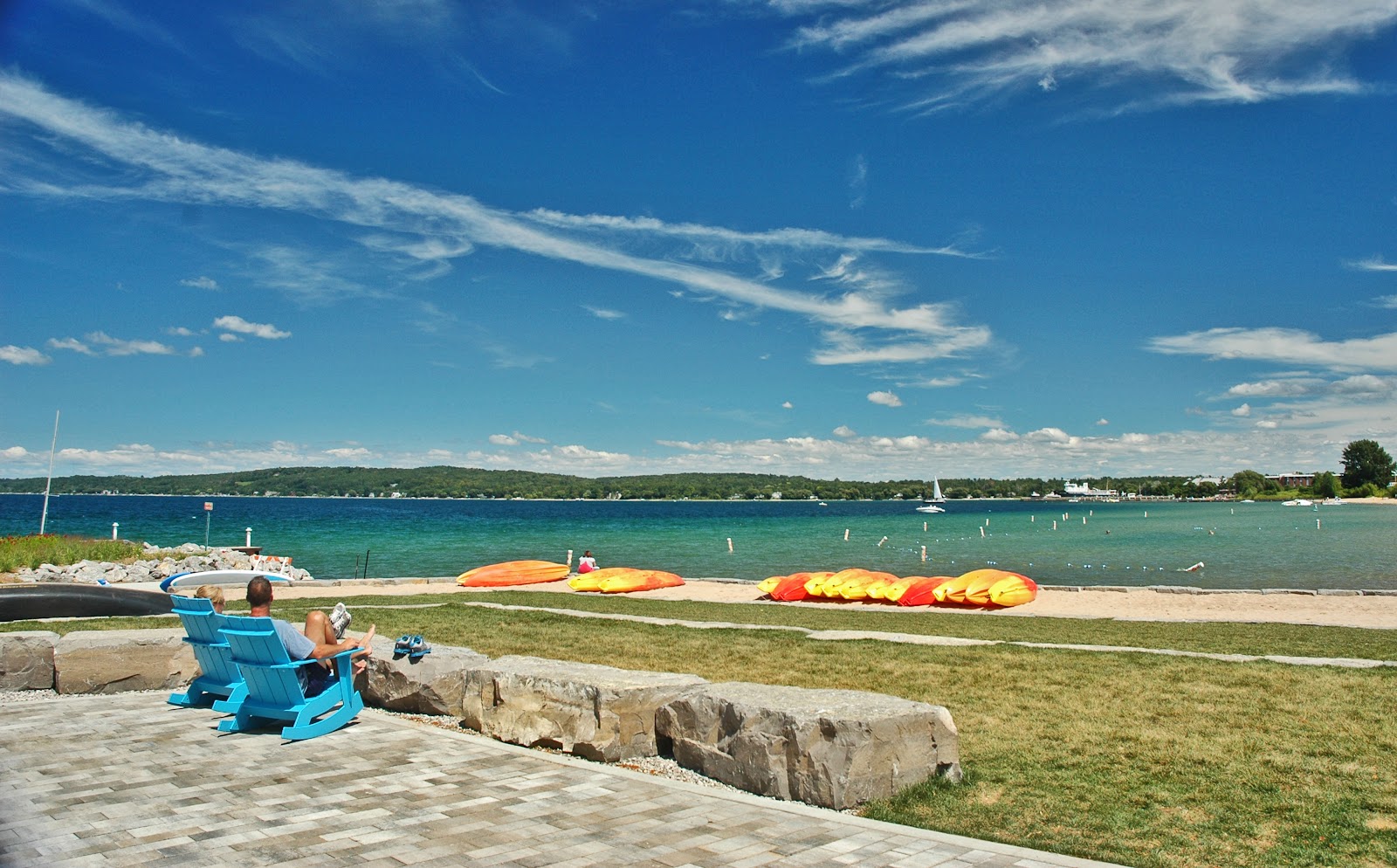
You've come down Grant Street to the beach, right on Lake Michigan, and you should feel the shift — the sand, the open water, the wind coming in off a lake so big it has a horizon like an ocean. Take a breath. This is the reward stop. But look down while you're breathing, because this beach is a treasure hunt, and it explains Earl Young better than any house.
Look at the pebbles at your feet. Somewhere in there — and people spend whole afternoons hunting for them — are Petoskey stones. They're the Michigan state stone, and they're not really stones at all. They're fossilized coral, the skeletons of a coral reef that lived here hundreds of millions of years ago, when this whole region sat at the bottom of a warm tropical sea. When they're wet, a faint honeycomb pattern glows up out of the surface — the actual ghost of individual coral animals that died before there were dinosaurs. You are on a beach in Michigan picking up pieces of a coral reef. That is real. That is just lying here.
And standing on this exact beach, you finally get Earl Young. Because this — this endless field of ancient stones washed up by the lake, every one of them older than anything human by an incomprehensible margin — this was his hardware store. This was where a man got the idea that stones have personalities. When your building material is literally fossil coral and glacier-carried boulders from a wa