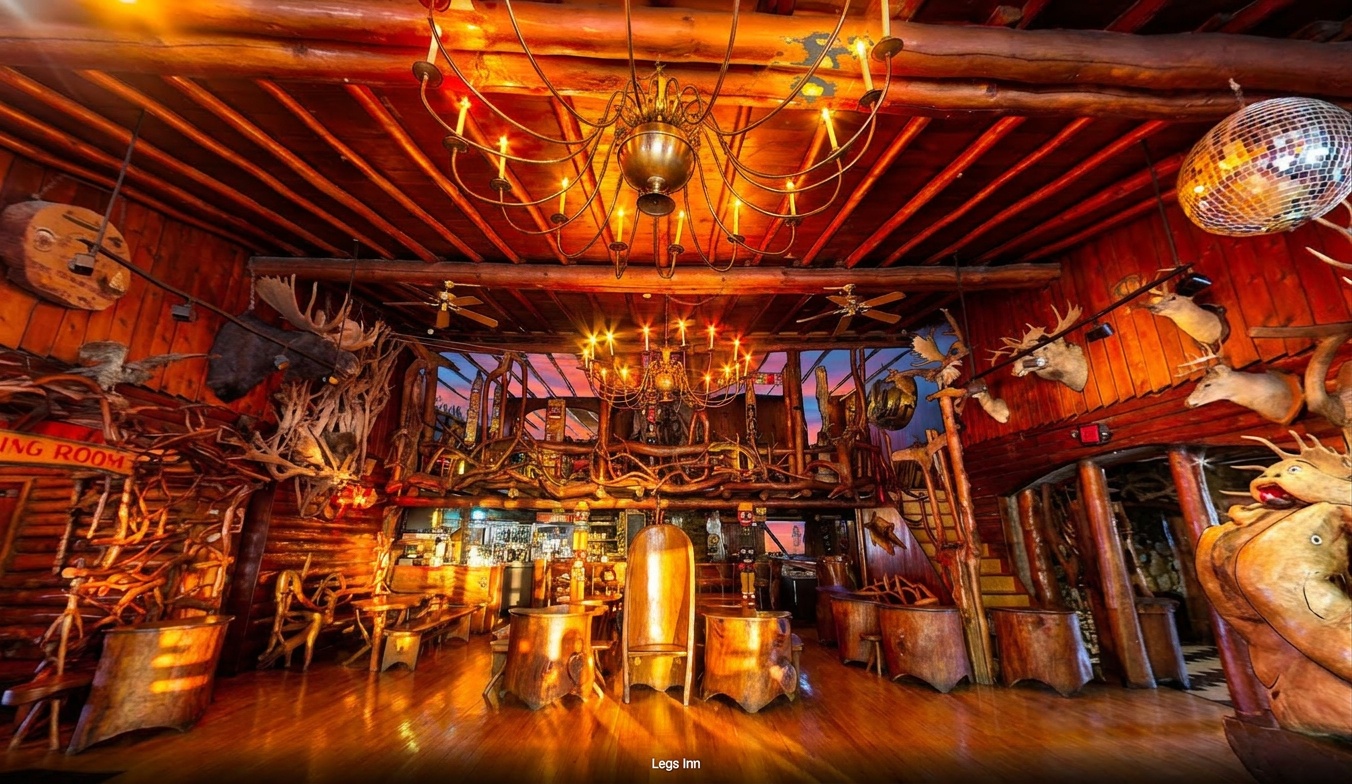
You've reached the end of the road. Cross Village. The tunnel of trees opens up, the big lake spreads out below the bluff, and standing right here at the finish line is the single strangest, most wonderful building on the entire route. Look at it. That is the Legs Inn, and I have been saving it for you this whole drive.
First, the name, because it's staring right at you. Look along the top edge of the roof — that whole parapet running across the roofline. Those are stove legs. Hundreds of old cast-iron legs, salvaged from wood-burning stoves, planted upside down in a row along the top of the building like a fence of black iron. That is literally why it's called the Legs Inn. A man roofed his restaurant with the legs of a few hundred dead stoves, and then named the place after them, and that was the most normal decision he made.
That man was Stanley Smolak. He came over from Poland in nineteen twelve, worked in the auto factories downstate for a while, and then in the early twenties h
e came up here to Cross Village and fell completely in love with the place and the people. And Stanley Smolak was a self-taught artist with a vision that I can only describe as a beautiful fever. He started building this place out of what the land gave him — local fieldstone, driftwood pulled off the beach, and the twisted roots and limbs of trees. And in all that driftwood and root, Smolak saw fa