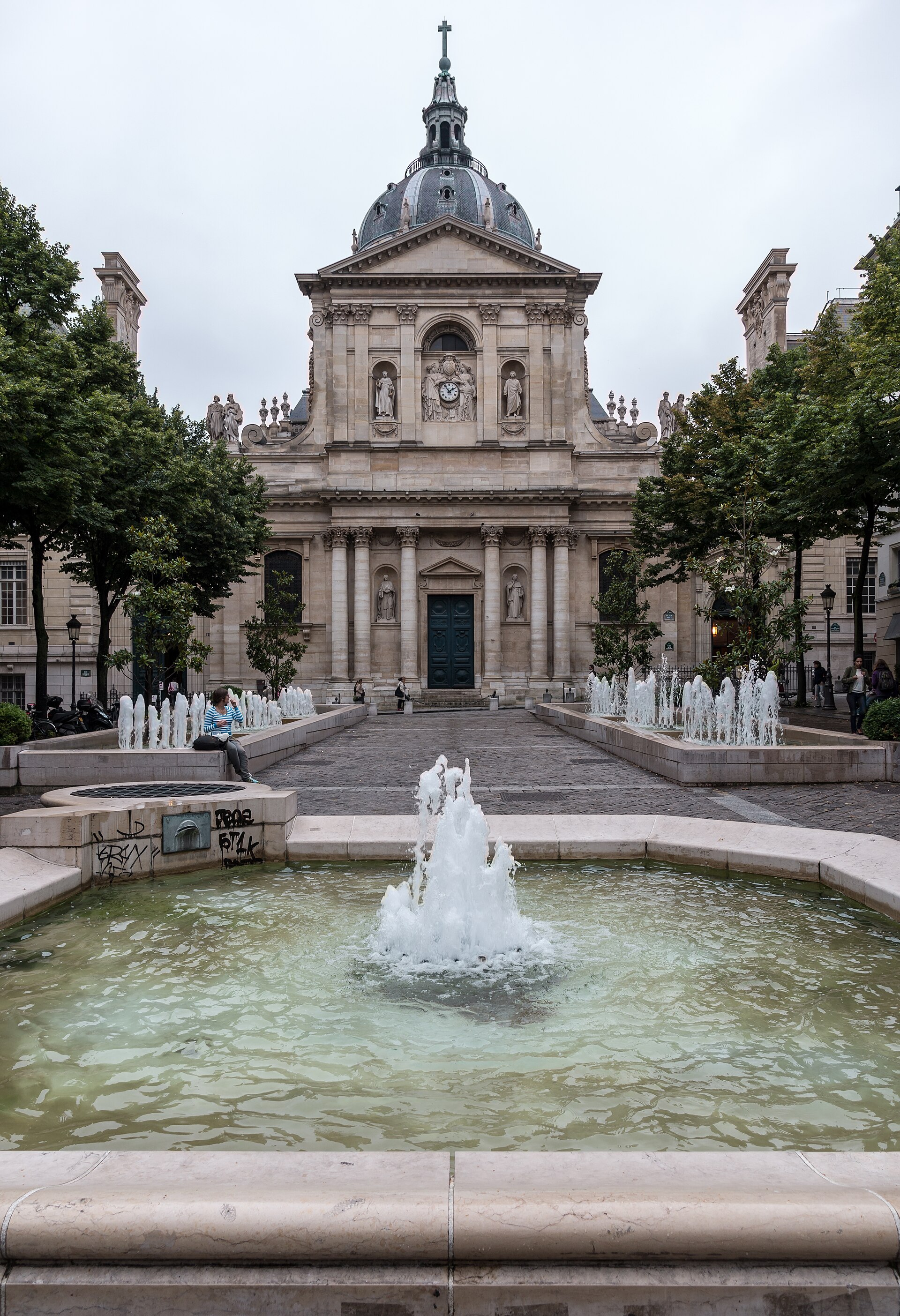
The square ahead of you, with the fountains and the café tables, is Place de la Sorbonne. The domed chapel at the end belongs to the oldest famous university in France. The square usually belongs to students, laptops, and cigarettes. Notice how calm it feels. The calm won't last the whole stop.
The Sorbonne started in twelve fifty-three, when a royal chaplain named Robert de Sorbon set up a house for sixteen poor theology students. They lived and studied for free. It grew into the university that taught Thomas Aquinas's Paris, examined Dante's ideas, and terrified kings. For roughly six hundred years, everything here happened in Latin — lectures, debates, arguments in the hallway. That's why this whole neighborhood is called the Latin Quarter. The name has nothing to do with the Romans. For six centuries, the students walking these streets were required to gossip in a dead language. The university statutes did allow one written exception: haggling with your landlord could be conducted
in French. Some negotiations were beyond Latin.
In nineteen oh-six, this university did something it had never done in six and a half centuries. Pierre Curie, the physics professor, was killed in the street — he slipped in front of a horse-drawn cart near the river. The Sorbonne offered his chair to his widow and research partner, Marie. She became the first woman ever to teach here. On the day