Luxembourg Gardens — The Grand Bassin

Luxembourg Gardens — The Grand Bassin

Paris, France

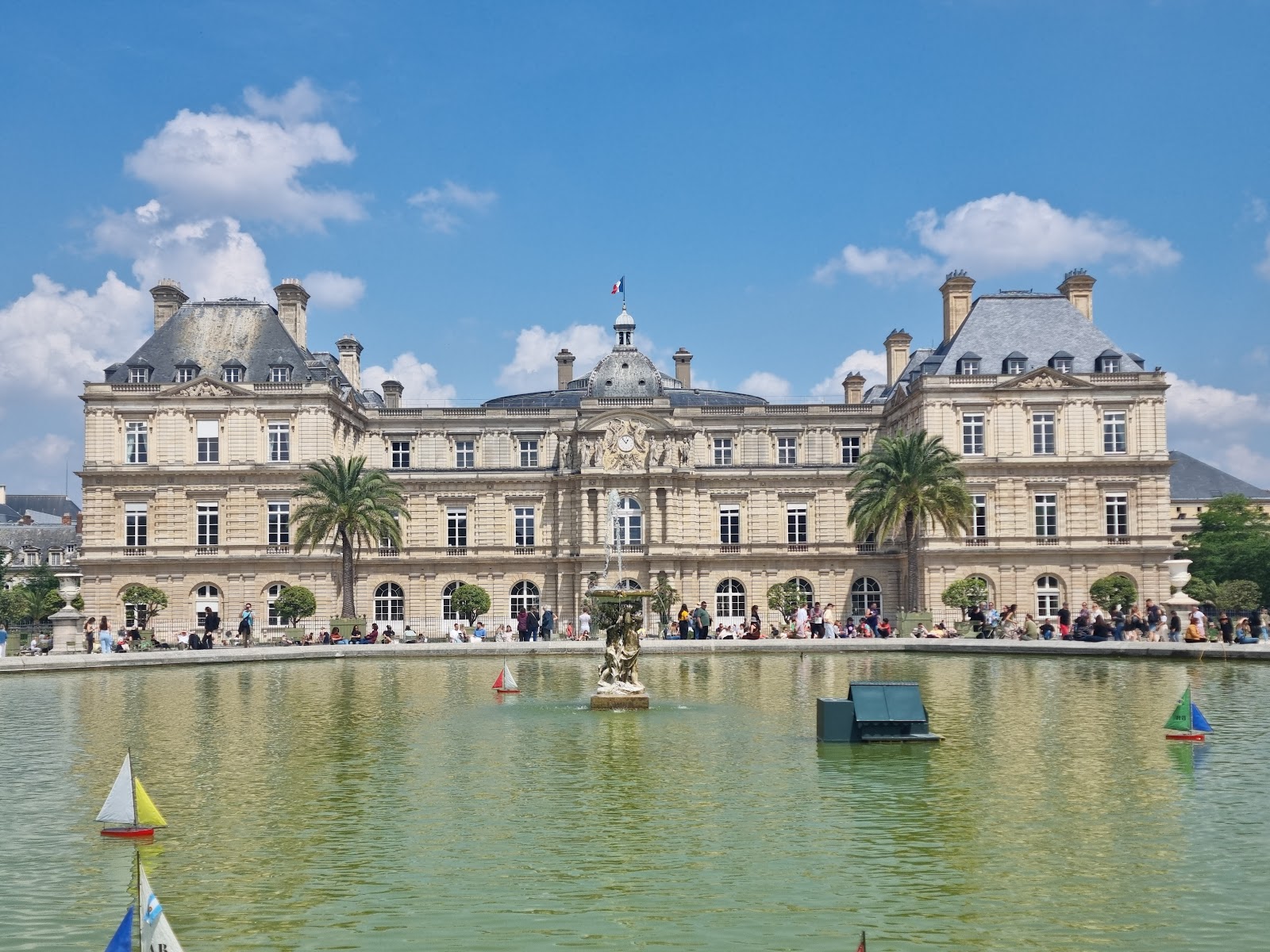
This is the Luxembourg Gardens, and the octagonal pond in front of the palace is the Grand Bassin. Gravel underfoot, green metal chairs everywhere, and — most days — a fleet of tiny sailboats working its way across the water.

This is the Luxembourg Gardens, and the octagonal pond in front of the palace is the Grand Bassin. Gravel underfoot, green metal chairs everywhere, and — most days — a fleet of tiny sailboats working its way across the water. Those boats are the story. We'll get to them.

The garden exists because of homesickness. Marie de Medici — say it MED-ih-chee — was a Florentine banker's daughter who married the King of France. When he was assassinated, the widowed queen decided she was done with gloomy French palaces. So in sixteen twelve she started building herself a piece of Florence. She modeled the palace on the one she grew up in, and matched it with Italian gardens and fountains. She wanted to look out a window and see home. Her palace is now where the French Senate meets, which means the lushest garden in Paris is technically a government office's front yard.

Ernest Hemingway did some of his hungriest walking right here. In the early twenties he was broke — genuinely, skipping-meals br

oke. He figured out that the Luxembourg was the best route across town for a hungry man. From one end to the other, there was nothing to smell and nothing to see that could be eaten. A park as a survival strategy. Years later he went further. He swore he'd lure the garden's pigeons with corn, dispatch them, and sneak them home under the blanket of his son's stroller. Historians suspect the pigeons
Hear the full story

Hear this story with audio narration in the Bad Historian app.

Get the App

Quick Facts

  • Marie de Médici, the homesick Florentine widow of the assassinated Henri IV, began building the palace and Italian-style gardens in 1612 to recreate the Florence of her childhood
  • The French Senate meets in her palace and administers the garden
  • Hemingway wrote in A Moveable Feast that he routed his walks through the Luxembourg when broke because there was nothing to smell and nothing to see that could be eaten
  • The story of luring pigeons with corn and smuggling them home under the blanket of his son's stroller is Hemingway's own tall tale, told later in life
  • Clément Paudeau began renting hand-built wooden sailboats at the Grand Bassin in 1927 for two sous apiece; he shaped the hulls and his wife hand-stitched the sails
  • The boats on the water today are the same physical hulls from 1927 — repainted, re-rigged, and patched, but no replicas
Featured Tour

The Left Bank: Thinkers, Drinkers & Dreamers

9 stops • 37 min

View Tour

Location

Paris, France
Open in Maps