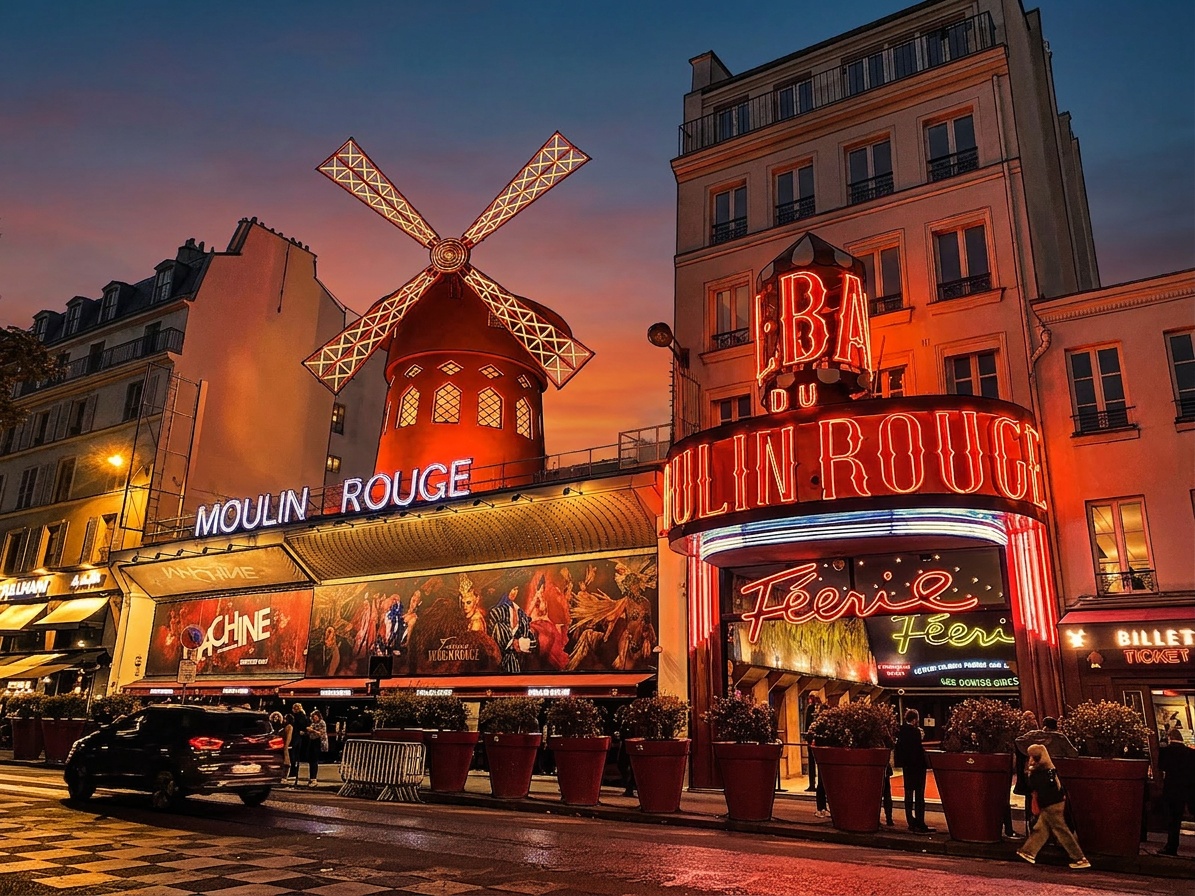
That red windmill. Eighty-two Boulevard de Clichy. It opened on October fifth, eighteen eighty-nine — the same year as the Eiffel Tower. Paris was in shock-the-world mode, and this was its contribution to nightlife.
Two men built it. Joseph Oller — a Spanish-born entrepreneur who had already invented the pari-mutuel betting system, which is the basis of all modern horse-race gambling. And Charles Zidler — a big, red-bearded showman who knew how to work a room. Together they built a dance hall, multiple bars, a garden — and in the garden, they installed a giant stucco elephant purchased from the World's Fair. The elephant was enormous. You could fit a small room inside its belly. And inside that belly, for men willing to pay extra, there were private belly-dancing performances. A secret show inside a fake elephant in the backyard of a cabaret. Eighteen eighty-nine.
The main attraction was the can-can. And the original was nothing like the chorus-line kick you've seen in movies. The or
iginal can-can was filthy. Dancers wore open drawers — or sometimes nothing underneath at all — and the high kicks were designed to flash the audience. Police were regularly sent to monitor the performances. The word can-can likely comes from the French for scandal.
And the biggest scandal of all was a woman named Louise Weber. Her stage name was La Goulue — the Glutton. She earned it as a teenag