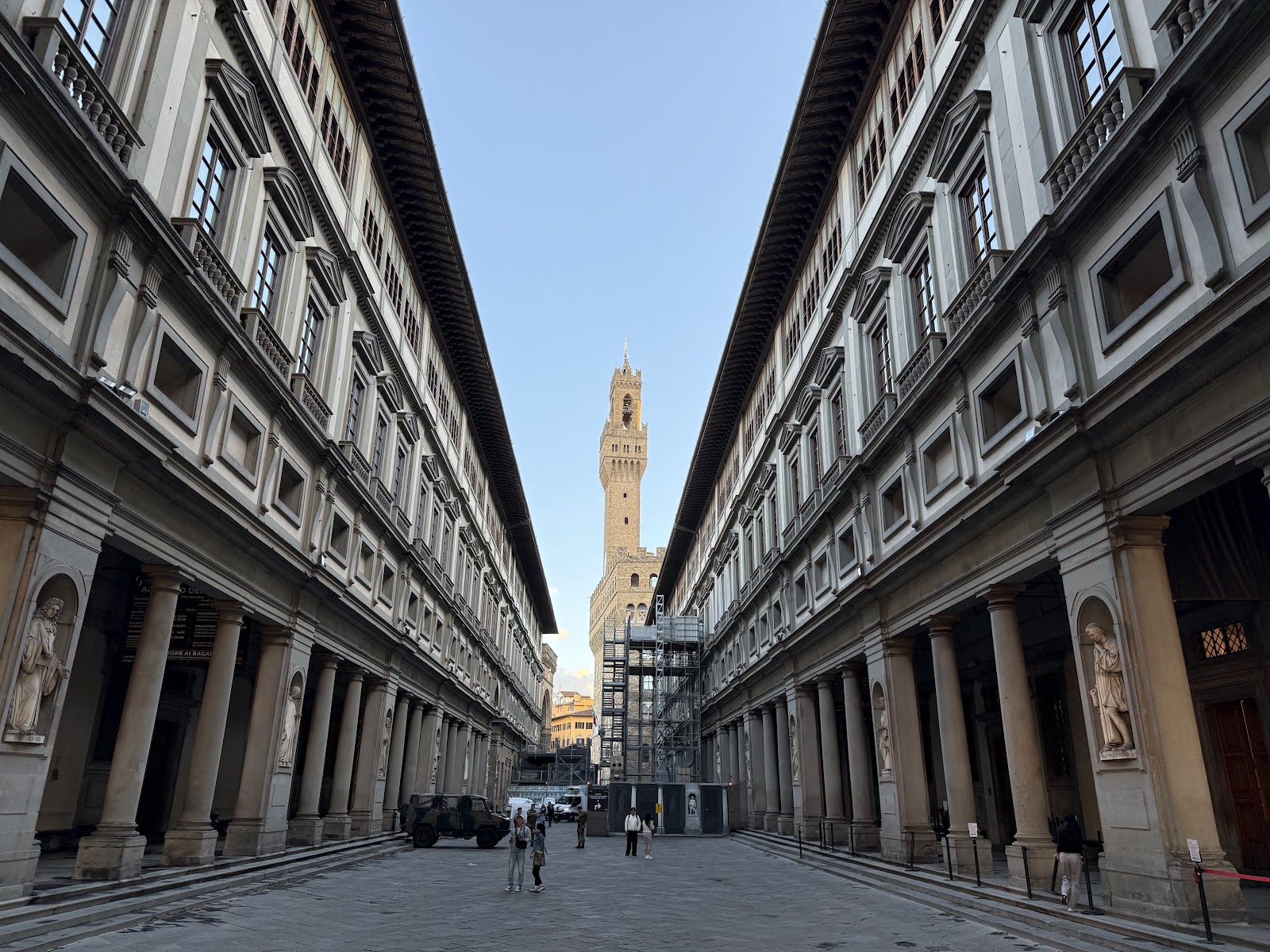
You're looking down a long, narrow stone courtyard that runs toward the river, hemmed by two matching wings and lined with statues of famous Florentines gazing down at you. This is the Uffizi, one of the greatest art museums that has ever existed — Botticelli, Leonardo, Michelangelo, Caravaggio, room after room of the most reproduced paintings on the planet. And the name is not grand, or Latin, or mysterious. Uffizi just means the offices.
Because that is precisely what Cosimo the First built here. He built a headquarters. He had a problem common to anyone who's just seized total control of a state: the actual machinery of government was scattered all over town. The courts here, the tax magistrates there, the guild tribunals somewhere else, the archives in a fourth building. Thirteen separate departments, thirteen sets of doors, thirteen places he couldn't watch at once. So he had Vasari build him one enormous, elegant office block to hold the entire administration of Tuscany, in a si
ngle U-shaped building, right next to his palace, all under one roof and one eye.
The building was a quiet act of nerve in its own right. Cosimo handed the job to Vasari, and Vasari set it down in about the worst place imaginable — the soft, waterlogged ground right at the lip of the Arno, where the bank could barely hold up a house, never mind a palace of state. He drove deep foundations into th