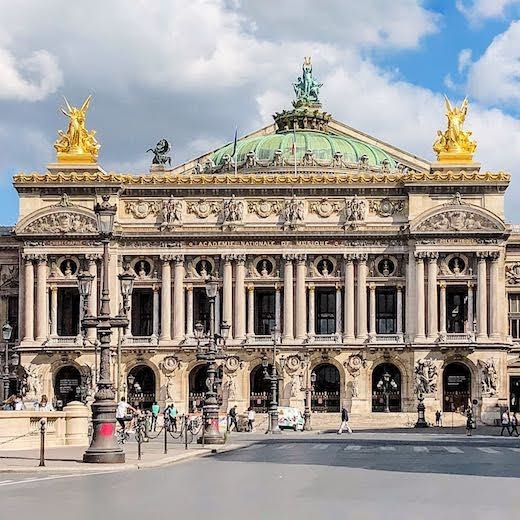
Palais Garnier

Palais Garnier

Paris, France

That enormous frosted cake of a building is the Palais Garnier — the Paris Opera. Gold statues on the roof, marble columns, busts of composers across the front.

That enormous frosted cake of a building is the Palais Garnier — the Paris Opera. Gold statues on the roof, marble columns, busts of composers across the front. It's the most expensive-looking building in a city that specializes in expensive-looking buildings.

In eighteen sixty, the Emperor announced a competition to design it. A hundred and seventy-one architects entered. The winner was Charles Garnier — say it Gar-nee-AY — a thirty-five-year-old nobody. Broke, unknown, the son of a blacksmith. In the first round of judging he came FIFTH. In the final round, the jury picked him unanimously. The most famous names in French architecture lost the biggest commission of the century to a kid nobody had heard of.

And the kid had opinions. When the Empress Eugénie looked at his design, she sniffed, what IS this style? It's not Greek, it's not Louis the Sixteenth. Garnier answered her to her face. "It is Napoleon the Third, Madame. And you complain." Telling an empress that her taste was beh

ind the times, at a design review, for her husband's opera house. He kept the job anyway.

Then the ground tried to kill the project. When workers dug the foundations, they hit groundwater, and it would not stop coming. Eight steam pumps ran day and night for months, and the site stayed a swamp. So Garnier stopped fighting the water and gave it a room. He built a huge sealed cistern under the buil
Hear the full story

Hear this story with audio narration in the Bad Historian app.

Get the App

Quick Facts

  • 171 architects entered the 1860 competition; Charles Garnier, a 35-year-old blacksmith's son, placed fifth in the first round and won the final unanimously
  • When Empress Eugénie sneered at his design, Garnier answered to her face: "It is Napoleon III, Madame. And you complain" — and kept the job
  • Groundwater flooded the foundations despite eight steam pumps, so Garnier built a sealed cistern under the building — a real underground lake that still works as a fire reservoir
  • Paris firefighters practice swimming in the cistern in total darkness, in full gear
  • In 1896 a chandelier counterweight fell through the ceiling and killed a concierge, Madame Chomette — Gaston Leroux turned it into the Phantom of the Opera's falling chandelier
  • Garnier made more than 15,000 drawings and designed the Grand Staircase as a stage where the audience performs for itself
  • Chagall's 1964 ceiling is painted on removable panels — the original ceiling survives intact underneath
  • Garnier had to buy his own 120-franc ticket to the 1875 opening night of his own opera house
Featured Tour

The Grand Boulevards: The Man Who Demolished Paris

9 stops • 40 min

View Tour

Location

Paris, France
Open in Maps