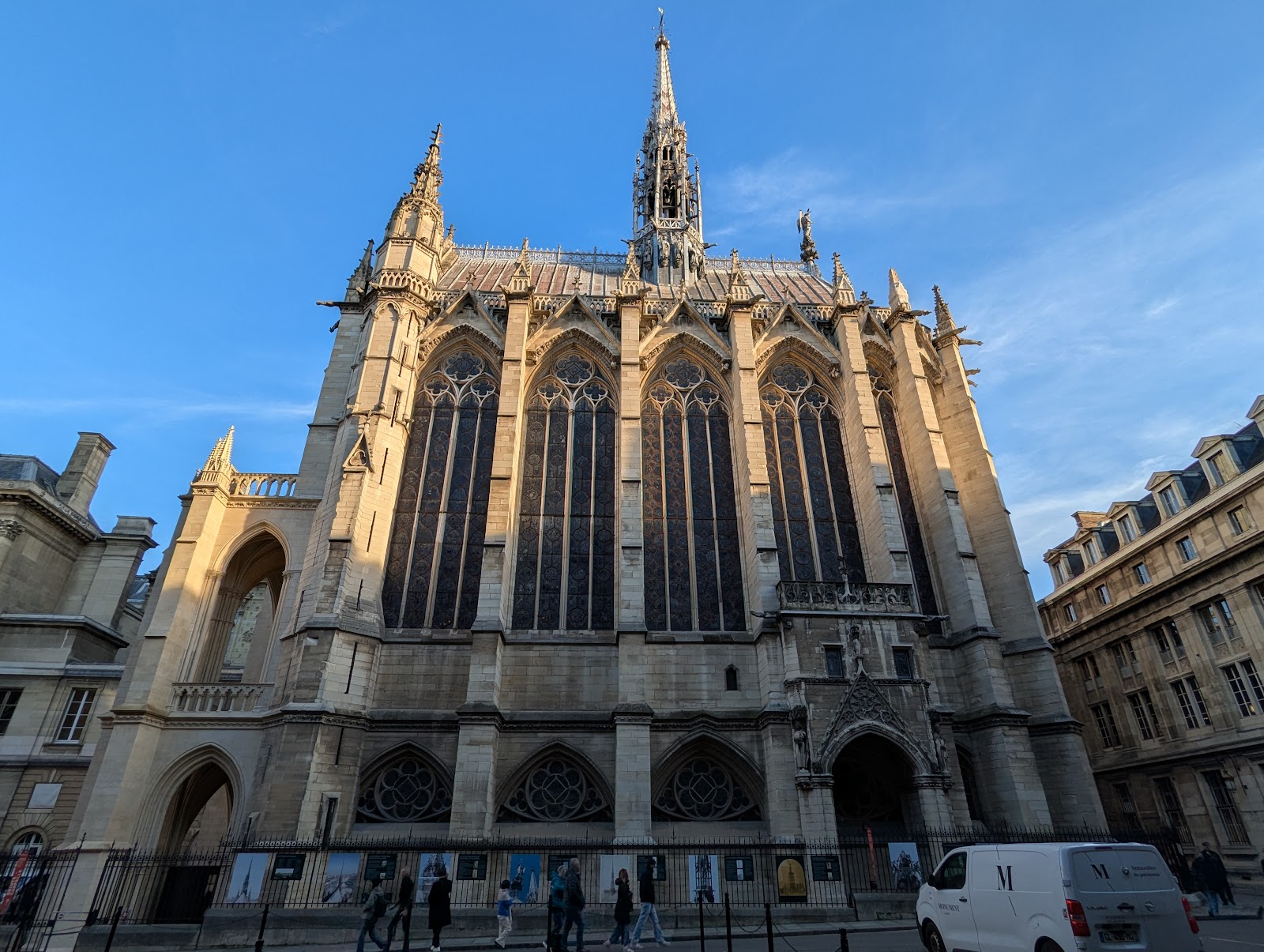
See that Gothic spire rising out of the middle of the law courts? That's Sainte-Chapelle — a thirteenth-century jewel box parked inside a working courthouse. To visit one of the most beautiful rooms on Earth, you go through airport-style security, past lawyers on their lunch break.
It exists because a medieval king spent a staggering fortune on a holy relic and needed somewhere worthy to keep it. That's the story every guide in Paris tells, so I'll leave it to them. I want to talk about the people who actually built the room.
The whole chapel went up in about six years. Notre-Dame, three hundred meters away, took a hundred and eighty-two. Six years, for fifteen stained glass windows, each one fifteen meters tall, holding one thousand one hundred thirteen separate scenes from the Bible. It's a comic strip the size of a building — you read each window bottom to top, left to right, panel by panel. Most of medieval Paris couldn't read a word. For those crowds, this was the entire story o
f creation in full color, floor to ceiling.
We don't know the name of a single person who made that glass. We know their recipes. They ground metal into the molten glass — cobalt for that deep blue, copper for the reds and greens, manganese for purple. And they mixed it by eye, in wooden huts, by firelight. Nearly two-thirds of the glass in that room is still theirs. Original. Eight hundred years