National Archives

National Archives

Washington DC, United States

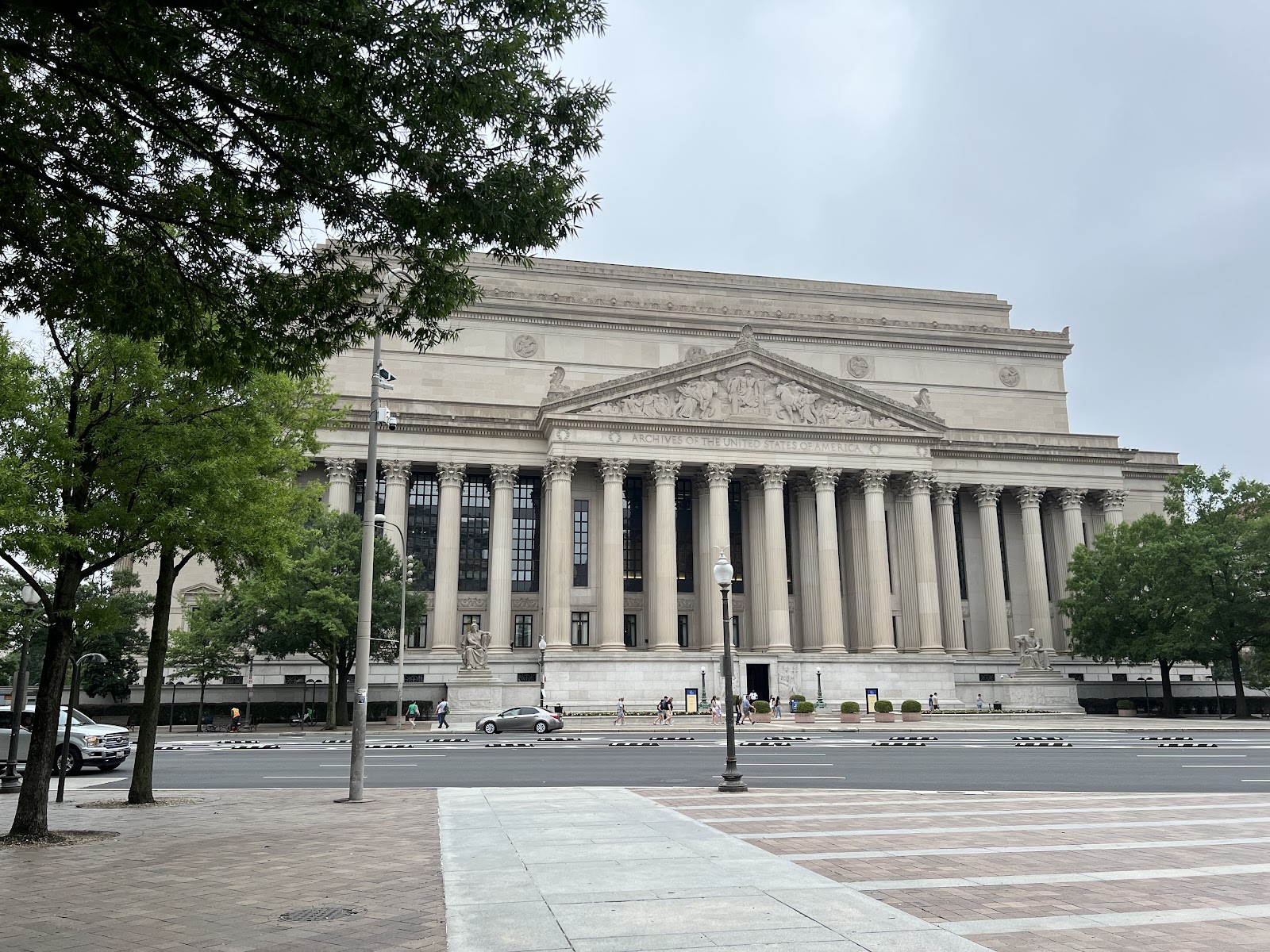
The National Archives.

The National Archives. Those columns — seventy-two of them, each fifty-three feet high, weighing ninety-five tons apiece. On the base of one of the statues out front, a quote from Shakespeare — "What is past is prologue."

Inside this building, right now, are the three documents Americans consider sacred — the Declaration of Independence, the Constitution, the Bill of Rights. And if you want to understand how America treats sacred things, this is a good place to start.

The Declaration was written with iron gall ink — made from crushed oak tree galls mixed with iron sulfate. It fades. It was never meant to last forever. And then we made sure it didn't.

In eighteen eighteen, the government wanted copies. An engraver named William Stone pressed a damp cloth against the original parchment and transferred the actual ink onto a copper plate. He may have done this to the signatures more than once. They literally squeezed the Declaration like a sponge.

Then a government official hung it on

a wall opposite a window — where it baked in direct sunlight for thirty-five years. During the War of eighteen twelve, a clerk named Stephen Pleasonton stuffed it into a linen sack. Carted it thirty-five miles by wagon to keep the British from burning it. During World War Two, it rode a Pullman sleeper car to Fort Knox. Spent three years sharing a vault with the nation's gold supply.

The result —
Hear the full story

Hear this story with audio narration in the Bad Historian app.

Get the App

Quick Facts

  • 72 Corinthian columns, each 53 feet high, 95 tons
  • "What is Past is Prologue" inscription (Shakespeare, The Tempest)
  • Declaration written with iron gall ink (crushed oak galls + iron sulfate)
  • 1818: William Stone wet-press copying transferred original ink to copper plate
  • 35 years in direct sunlight at Patent Office (1841-1876)
  • War of 1812: Stephen Pleasonton evacuated in linen sacks, 35 miles to Leesburg
  • WWII: Fort Knox Compartment 24, 1941-1944
  • Declaration now essentially illegible
  • Bill of Rights: 14 originals ordered, only 8 states still have copies
  • Maryland's copy: just gone; state has no idea what happened
  • North Carolina copy: stolen by Union soldier, sold for $5, disappeared 138 years
  • Wayne Pratt (Antiques Roadshow) tried to sell it; FBI sting 2003
  • Originally 12 amendments proposed; 10 ratified as Bill of Rights
  • Article 2 (Congressional pay) sat unratified 202+ years
  • Gregory Watson: UT Austin sophomore, 1982; professor Sharon Waite gave him a C
  • Watson campaign: Maine first (1983), Michigan 38th (1992) = 27th Amendment
  • Grade officially changed to A+ decades later (with help of Prof. Zachary Elkins)
Featured Tour

Dead Letters and Cursed Gems

9 stops • 2h 30m

View Tour

Location

Washington DC, United States
Open in Maps